Shadmehr Laboratory
Laboratory for Computational Motor Control · Johns Hopkins University
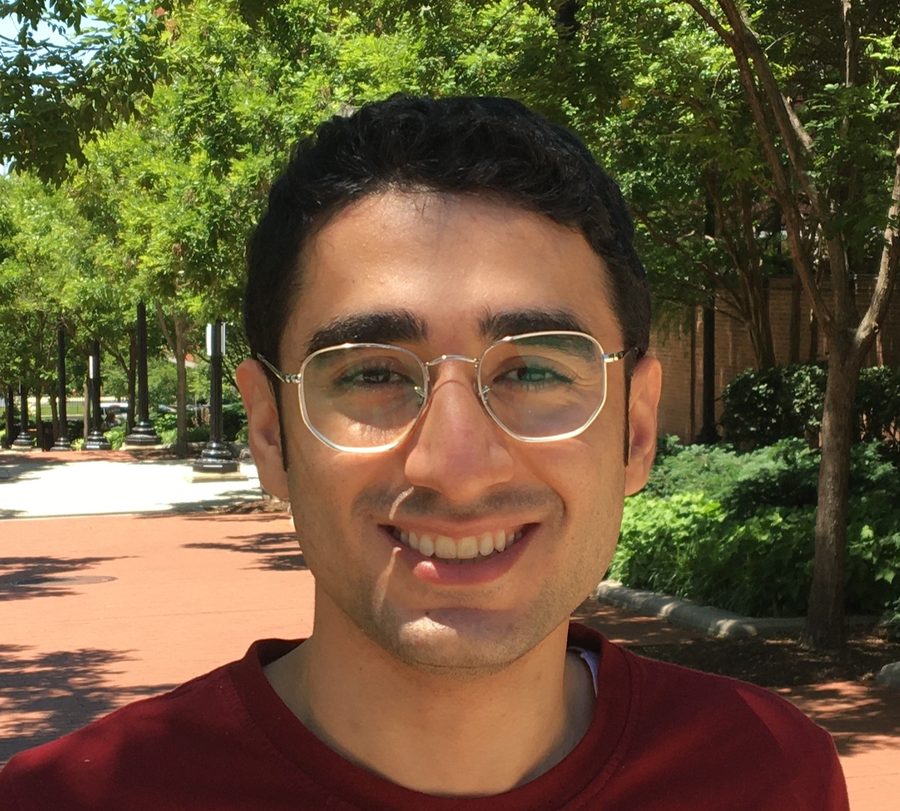
Amin Fakharian

Amin Fakharian

PhD (2025)

Research

Amin joined the lab in 2021 as a graduate student in the BME PhD Program. He received a BS in Electronic Engineering from Sharif University of Technology, followed by an MS from Sharif. He was ranked 1st among all Sharif EE students. Amin's research focues on the neural control of movements in marmosets, using silicon probes to record simultaneously from many neurons in the cerebellum. He played a critical role in building P-sort, an open-source tool for analysis of cerebellar neurophysiological. Amin discovered that the mossy fiber input to the cerebellum provides two kinds of information: the goal of the movement in sensory coordinates, and the real-time state of the eyes as the brain attempts to achieve the goal. This discovery is likely to play a critical role in realtime neural decoding of the cerebellum. Amin discovered a vector calculus in the cerebellum, demonstrating that each Purkinje cells was active to partially cancel the downstream effects of other Purkinje cells. During saccades, the cells together computed a function that assisted the motion of the eyes toward the target, then assisted in stopping that motion. Amin was awarded the Claude and Barbara Migeon prize for outstanding research by a graduate student at Johns Hopkins School of Medicine. Amin graduated in 2025, and subsequently started a postdoctoral fellowship with Mehrdad Jazayeri at MIT.

Ideas developed by Amin

  • Discovering a vector calculus for neural computation in the cerebellum. Amin developed an approach for estimating the contribution of individual Purkinje cells to movement using spike-triggered averaging. His work showed that each Purkinje cell has a potent vector describing its influence on eye movements. Spikes from different Purkinje cells combine through vector superposition, allowing population activity to generate specific motor effects.
  • Demonstrating that neural activity can cancel unwanted motor commands. Amin showed that Purkinje cells are active during movements in many directions, even when their individual motor effects are inconsistent with the intended movement. The simultaneous activity of competing populations allows unwanted components of motor output to cancel, while preserving components that contribute to the desired movement. This provided experimental support for null space computation in the brain.
  • Developing a framework for understanding the neural language of the cerebellum. Amin contributed to a computational framework in which Purkinje cells act as vector-generating basis functions. Rather than encoding movement parameters through their individual firing rates, Purkinje cells collectively control behavior through the timing and superposition of their motor effects. This framework suggests that competing populations of Purkinje cells can guide movements toward their goals and determine when movements should terminate.
  • Investigating how coordinated Purkinje cell activity contributes to movement. Amin contributed to experiments examining synchronous spiking among Purkinje cells and the relationship between complex spikes and movement. These studies demonstrated that coordinated spike timing and complex spike events can influence motor output, providing evidence that cerebellar computation depends on the temporal organization of neural activity as well as changes in firing rates.
  • Investigating cerebellar control of movement deceleration. Amin contributed to research showing that Purkinje cells regulate the deceleration of tongue movements in behaving marmosets. Together with his work on eye movements, these findings suggest that cerebellar population activity helps determine how movements approach their goals and are brought to a controlled stop.
  • Developing experimental and computational tools for cerebellar neurophysiology. Amin contributed to the development of P-sort, an open-source software package for identifying simple and complex spikes in extracellular Purkinje cell recordings. He also participated in behavioral studies of effort-dependent foraging in marmosets. These contributions helped expand the experimental and analytical approaches available for studying cerebellar function during behavior.
  • Selected publications

    Shadmehr R, Fakharian MA. A neural language for the cerebellum: control of behavior via competing populations of Purkinje cells. Journal of Neurophysiology. 2026;135:557–578.

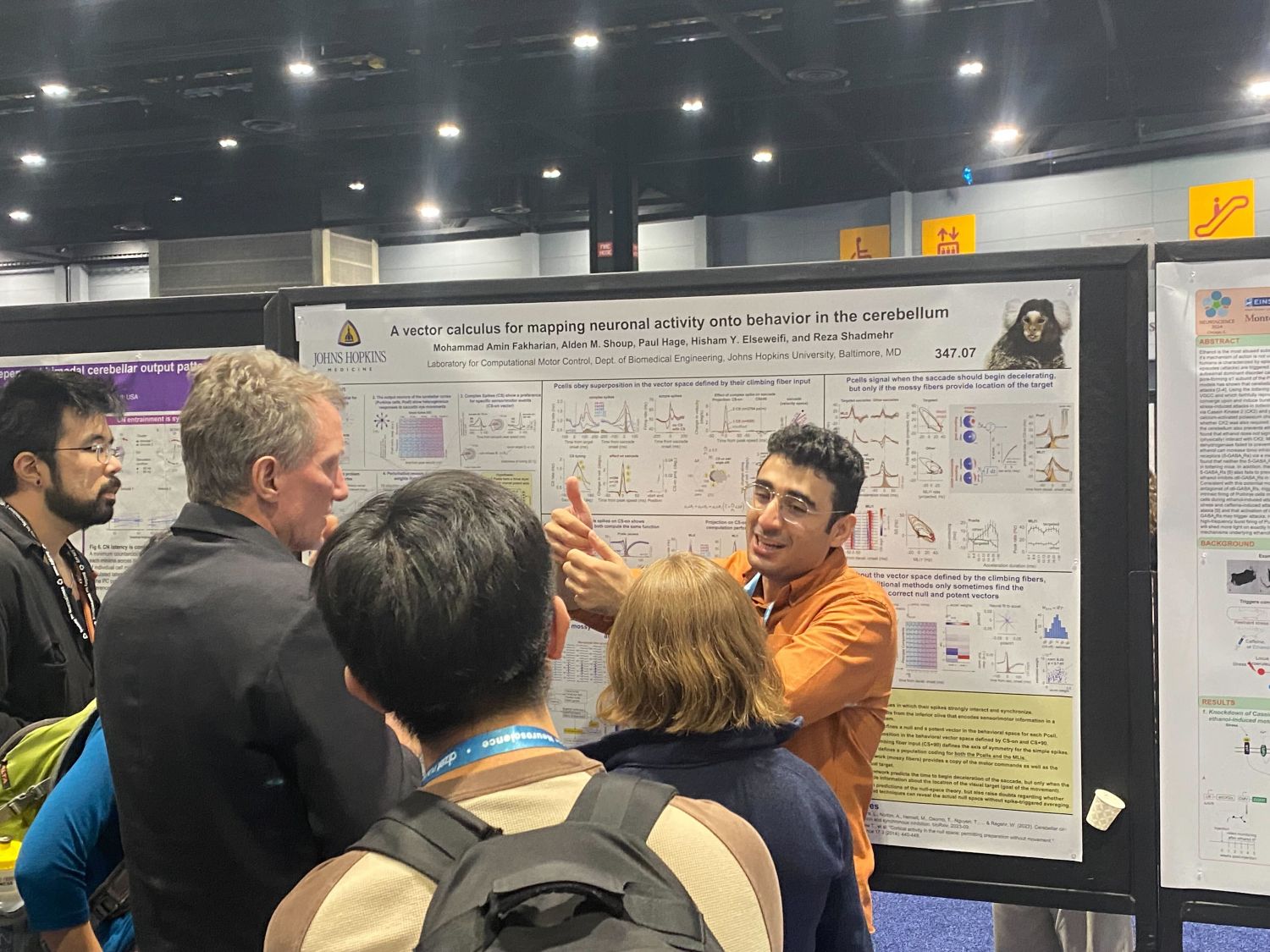
    Fakharian MA, Shoup AM, Hage P, Elseweifi HY, Shadmehr R. A vector calculus for neural computation in the cerebellum. Science. 2025;388(6749):869–875.

    Hage P, Fakharian MA, Shoup AM, Pi JS, Sedaghat-Nejad E, Orozco SP, et al. Purkinje cells of the cerebellum control deceleration of tongue movements. PLoS Biology. 2025;23(4):e3003110.

    Hage P, Jang IK, Looi V, Fakharian MA, Orozco SP, Pi JS, Sedaghat-Nejad E, Shadmehr R. Effort cost of harvest affects decisions and movement vigor of marmosets during foraging. eLife. 2023;12:RP87238.

    Muller SZ, Pi JS, Hage P, Fakharian MA, Sedaghat-Nejad E, Shadmehr R. Complex spikes perturb movements and reveal the sensorimotor map of Purkinje cells. Current Biology. 2023;33(22):4869–4879.e3.

    Sedaghat-Nejad E, Pi JS, Hage P, Fakharian MA, Shadmehr R. Synchronous spiking of cerebellar Purkinje cells during control of movements. Proceedings of the National Academy of Sciences. 2022;119(14):e2118954119.

    Sedaghat-Nejad E, Fakharian MA, Pi JS, Hage P, Kojima Y, Soetedjo R, Ohmae S, Medina JF, Shadmehr R. P-sort: an open-source software for cerebellar neurophysiology. Journal of Neurophysiology. 2021;126(4):1055–1075.

    Fakharian MA. Cerebellar Microcircuits: From Rate Coding to Spike Temporal Coordination PhD Dissertation. Johns Hopkins University, 2025.

    Gallery
    ← Return to lab members