Neural control of movements
Our laboratory combines mathematics, human behavior, and neurophysiology in nonhuman primates to understand how the brain predicts the consequences of actions, learns from errors, and turns neural activity into movement.
A neural language for the cerebellum
How can thousands of Purkinje cells act together to control a single movement?
Individual Purkinje cells do not simply report the direction of an eye movement through their firing rates. A cell can fire during movements in many directions, yet each spike has a measurable downstream influence—a potent vector in the space of movement.
By measuring the consequences of spikes and combining these vectors across simultaneously active cells, we found that populations of Purkinje cells can construct a motor command through superposition and cancellation. Components that would move the eyes in unwanted directions cancel, while the remaining activity helps guide the eyes toward their goal.
Related work examines how complex spikes perturb movements, how climbing fibers distinguish sensory events from movement plans, how synchronized Purkinje cell activity shapes output, and how the cerebellum controls the deceleration of tongue movements.
Movement vigor reflects the value of action
The brain decides not only what to do, but how energetically to do it.
Movements toward valuable goals tend to be more vigorous. This observation led us to propose that movement vigor provides a window into the brain's estimate of the subjective value of an action, incorporating expected reward, effort, and time.
Studies of eye movements, reaching, and foraging connected decision-making to movement execution: the computations that influence which action is worth taking can also influence the speed and energy with which it is performed.

A memory of errors
Learning from an error depends on the errors that came before it.
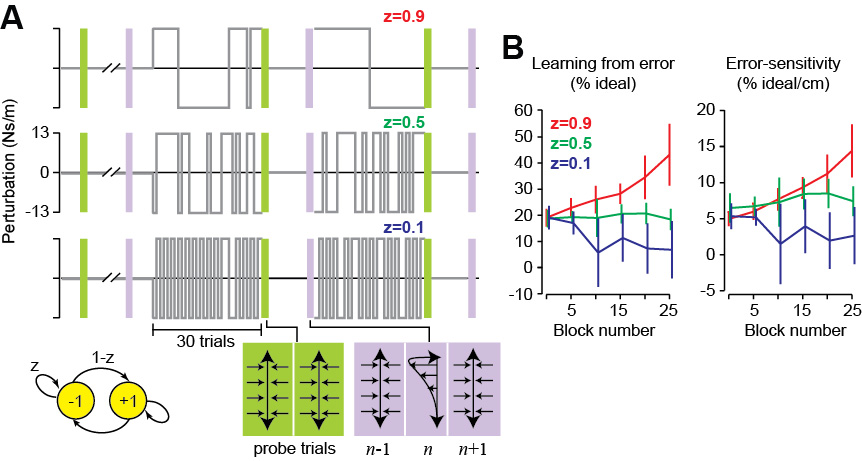
Motor adaptation is not governed by the current error alone. We found that the history of experienced errors changes how strongly the brain responds to a new error. Repeated errors of a consistent kind can increase sensitivity to future errors, while inconsistent errors can reduce it.
This idea adds a second kind of memory to sensorimotor learning: not only a memory of the motor command, but also a memory that adjusts the learning rate itself.
Learning unfolds across multiple timescales
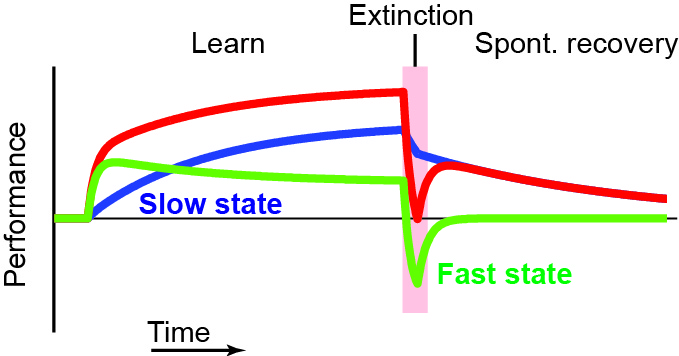
The multiple timescales of memory give rise to spontaneous recovery after extinction
Adaptation reflects the interaction of processes with different learning and retention properties. A fast process responds strongly to error but forgets quickly; a slow process learns more gradually but retains what it has learned.
This framework explains patterns of adaptation, forgetting, and savings that cannot be understood as a single uniform memory. It provides a mathematical account of how short-lived and persistent changes coexist during skill acquisition. Importantly, it provides an explanation as to why extinction training does not erase memories, and instead is followed by spontaneous recovery.
Internal models: learning to predict the world
The brain learns how the world responds to our actions—and uses those predictions to move.
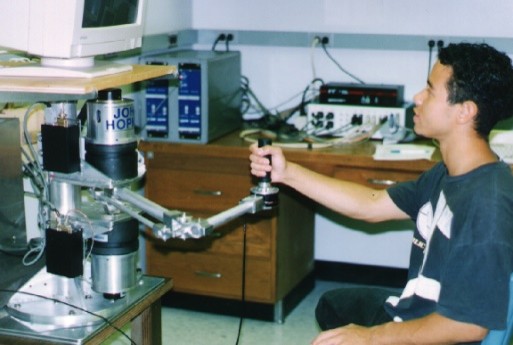
In our early experiments, people reached while a robotic device applied unfamiliar forces to their hands. Their initial movements were distorted. With practice, the trajectories straightened; when the forces were removed, the hands deviated in the opposite direction.
These aftereffects revealed that the nervous system had learned a predictive representation of the new dynamics rather than merely reacting to each disturbance. The force-field adaptation paradigm became a widely used experimental approach to studying internal models, sensory prediction errors, and the role of the cerebellum in motor learning.