Shadmehr Laboratory
Laboratory for Computational Motor Control · Johns Hopkins University
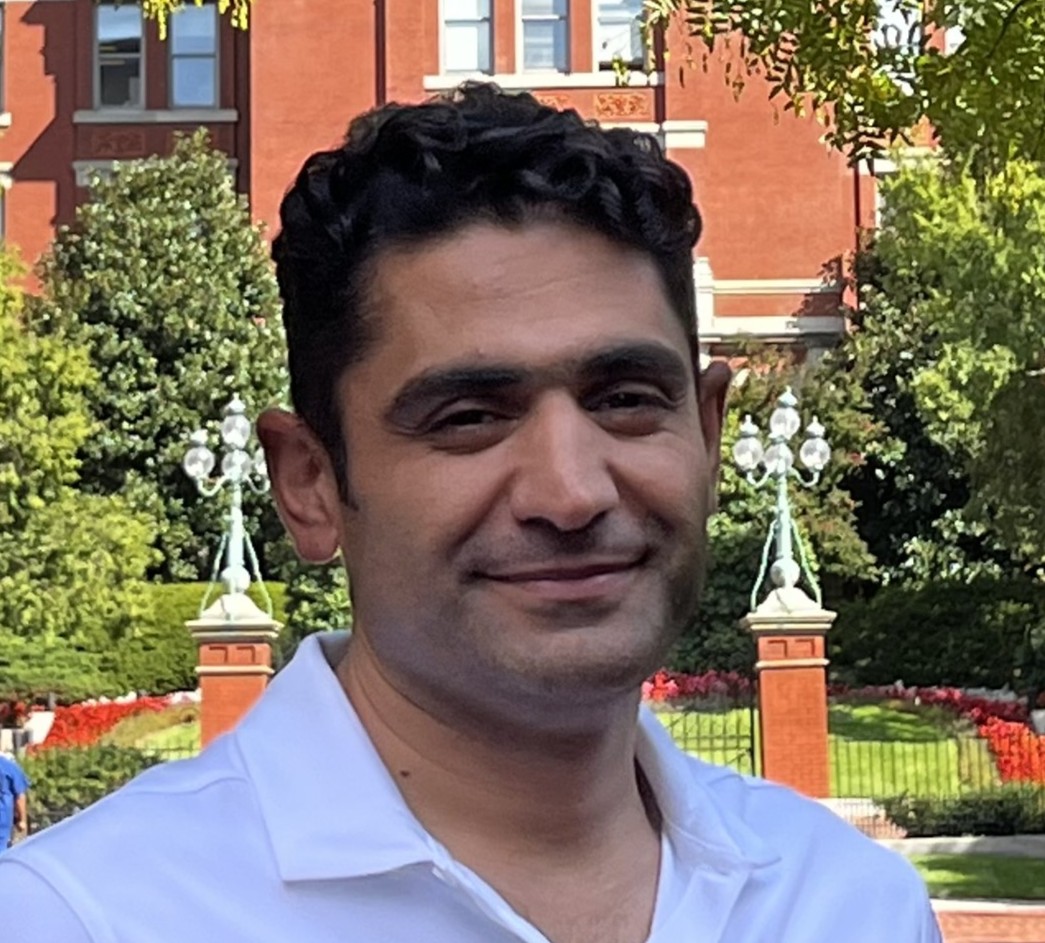
Jafar Doostmohammadi

Jafar Doostmohammadi

Postdoctoral fellow (2023-26)

Research

Jafar joined the lab in 2023 as a post-doctoral fellow after completing a PhD in Neuroscience from the Univ. of Tehran, and a post-doctoral fellowship at McGill University. Jafar's work has focused on Neuropixels recordings from the marmoset cerebellum during value-based decision-making. He discovered that the cerebellum receives regarding rewarding value of an action, and then uses this information to better control movements. Moreover, Jafar discovered that the climbing fiber input to the oculomotor region of the vermis of the cerebellum encoded both sensory and reward prediction errors.

Ideas developed by Jafar

  • Climbing fibers provide the gradient of a loss function to the cerebellum The credit assignment problem in the brain refers to the fact that in a multi-layer network, each neuron requires a teaching signal that considers that neuron's downstream connections. Thus, a good teacher cannot simply broadcast the error to all the neurons. Rather, it must tailor its signal to consider both the subjective context in which the error was experienced, termed the loss function, and the objective role that each neuron played in producing the movement, termed the neuron’s potent vector. Are there neurons in the brain that compute the sophisticated teaching signal as required by gradient descent? Jafar discovered the first example of such a signal in the brain. Jafar discovered that the information transmitted by climbing fibers, which are the principal teachers of the cerebellum, combined the subjective, reward-dependent context in which the error was experienced, i.e., the loss function, with the objective, individual role that the Purkinje cells (P-cells) played in producing the movement, i.e., the neuron’s potent vector. Thus, the climbing fibers solved the credit assignment problem by providing the gradient of a loss function with respect to the output of the P-cells that they innervated. This implies that the inferior olive provided a surprisingly sophisticated solution to the credit assignment problem. The signal in the climbing fiber was not merely a prediction error, nor merely a reward signal, but a neuron-specific gradient that instructs the P-cell on how to change its activity to reduce future loss.
  • Selected publications

    Jafar Doostmohammadi, Nazanin Mohammadrezaei, Hisham Y. Elseweifi, Alana D. Chandler, Elijah A. Taeckens, Reza Shadmehr Climbing fibers encode the gradient of a loss function for the cerebellum Biorxiv, 2026.

    Gallery
    ← Return to lab members