Shadmehr Laboratory
Laboratory for Computational Motor Control · Johns Hopkins University
Mollie Marko

Mollie Marko

PhD (2014)

Research

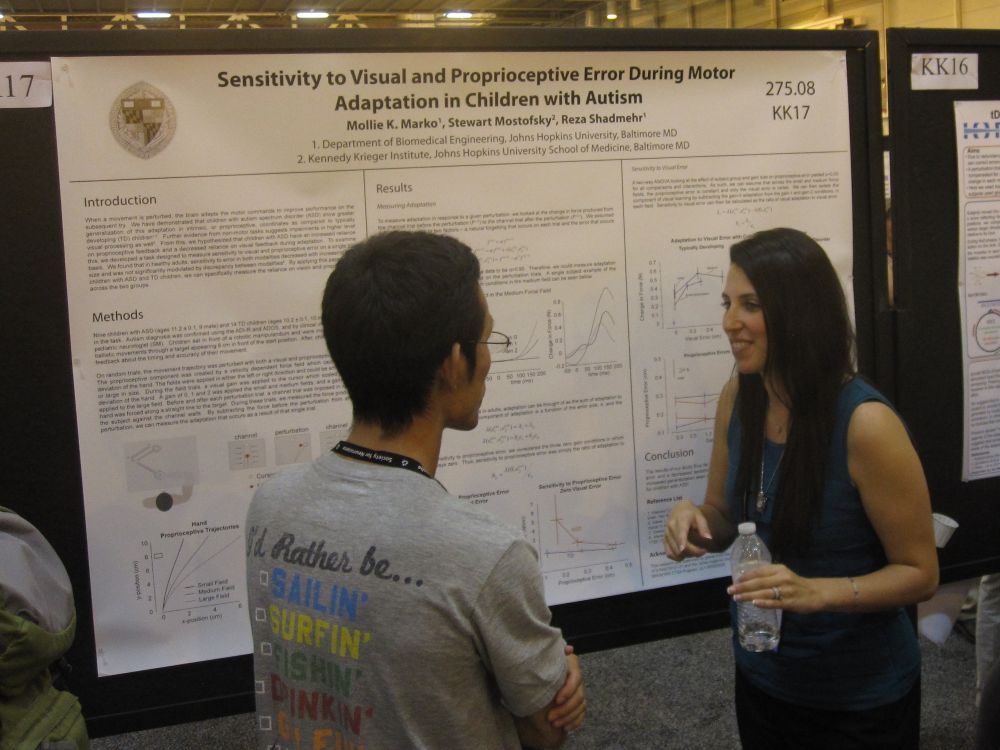
Mollie graduated from Rutgers University in 2009. She was distinguished as a Robert Byrd Scholar, ann an Edward Bloustein Scholar. She joined the lab in 2009 as a BME PhD student. Mollie advanced our understanding of motor learning by demonstrating that sensitivity to prediction error depends on the statistics of prior experience of errors. Mollie’s major work was focused on autism. Her imaging work uncovered significant abnormalities in the cerebellum of children with autism spectrum disorders. Her behavioral work in these children demonstrated that they learned internal models of action in a way that was quite different than typically developing children: they relied more on proprioception that visual sensory information. She completed her PhD in 2014 and subsequently joined Synchrogenix.

Ideas developed by Mollie

  • Characterizing how the nervous system learns from sensory prediction errors. Mollie investigated how the magnitude of a movement error influences the amount of learning that follows. Her work showed that sensitivity to prediction error is nonlinear: larger errors do not necessarily produce proportionally larger changes in motor commands. These findings helped establish that the nervous system regulates how strongly it learns from errors of different magnitudes.
  • Discovering that the nervous system maintains a memory of errors. Mollie contributed to work demonstrating that motor learning depends not only on the current error but also on the history of previously experienced errors. When errors repeatedly occur in the same direction, the nervous system increases its sensitivity to them. When errors are inconsistent, sensitivity decreases. This established a mechanism through which the brain adjusts its learning rate according to the statistical structure of errors.
  • Identifying altered sensory integration and motor learning in autism. Mollie investigated why children with autism exhibit unusual patterns of motor adaptation. Her work provided evidence that motor learning in autism relies excessively on proprioceptive information relative to visual information. Subsequent experiments linked these behavioral differences to alterations in neural systems involved in motor learning, helping connect atypical sensory integration to the neurobiology of autism.
  • Investigating how motor cortex contributes to the generalization of motor learning. Mollie contributed to experiments using noninvasive brain stimulation to examine how motor learning transfers from trained movements to untrained movements. This work demonstrated that altering motor cortical excitability can change the spatial generalization of adaptation, providing evidence that motor cortex contributes to how learned motor commands are represented and transferred across movements.
  • Selected publications

    Marko MK, Crocetti D, Hulst T, Donchin O, Shadmehr R, Mostofsky SH. Behavioral and neural basis of anomalous motor learning in children with autism. Brain. 2015;138:784–797.

    Herzfeld DJ, Vaswani PA, Marko MK, Shadmehr R. A memory of errors in sensorimotor learning. Science. 2014;345:1349–1353.

    Marko M. Sensitivity to motor error in children with autism. PhD thesis, Johns Hopkins University. 2014.

    Izawa J, Pekny SE, Marko MK, Haswell C, Shadmehr R, Mostofsky SH. Motor learning relies on integrated sensory inputs in ADHD, but over-selectively on proprioception in Autism spectrum conditions. Autism Research. 2012;5:124–136.

    Marko MK, Haith AM, Harran MD, Shadmehr R. Sensitivity to prediction error in reach adaptation. Journal of Neurophysiology. 2012;108:1752–1763.

    Orban de Xivry JJ, Marko MK, Pekny SE, Pastor D, Izawa J, Celnik P, Shadmehr R. Stimulation of the human motor cortex alters generalization patterns of motor learning. Journal of Neuroscience. 2011;31:7102–7110.

    Gallery
    ← Return to lab members