Research
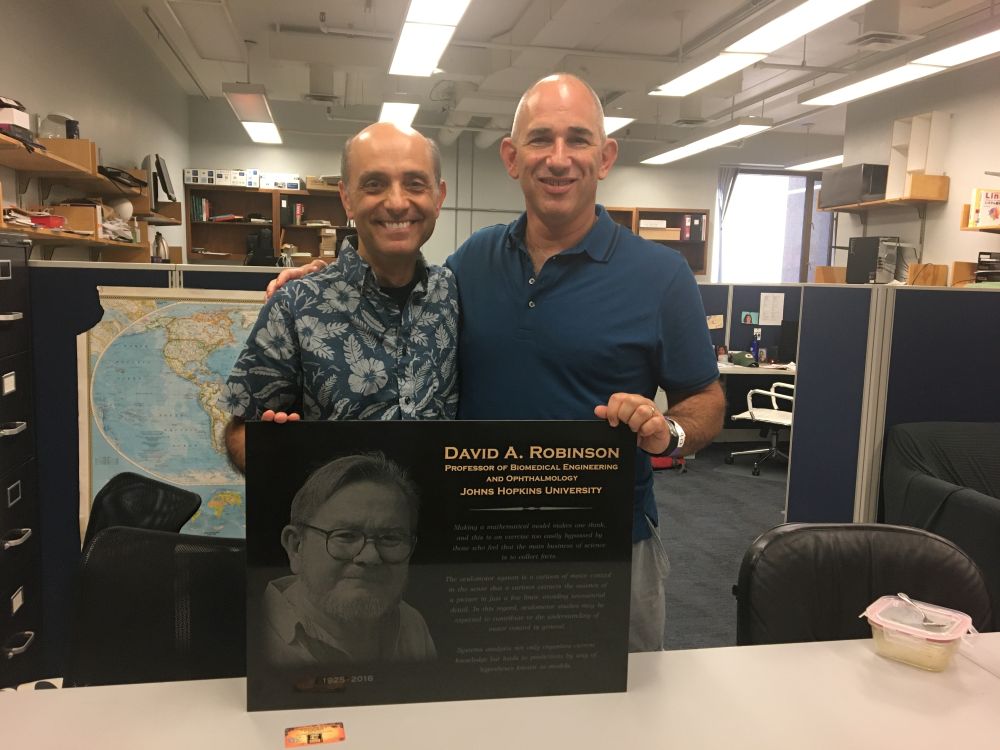
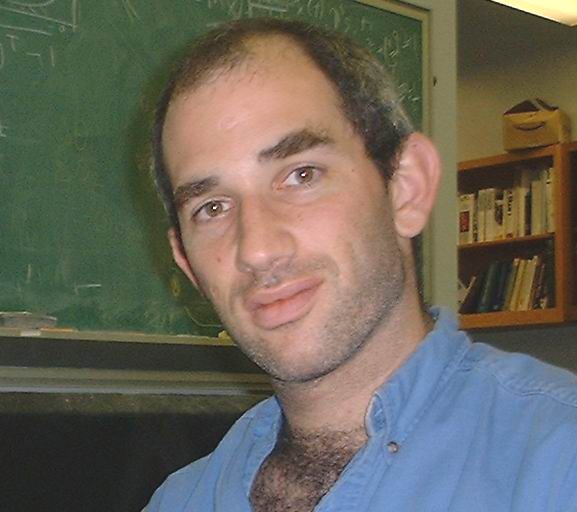
Opher joined the lab in 2000, after completing a PhD in Computational Neuroscience from Hebrew University, and a BS in Mathematics from MIT. He won a Whitaker Distinguished Postdoctoral Fellowship from the Biomedical Engineering program at Johns Hopkins. Opher's research led to extension of the state-space approach to quantify generalization patterns in motor learning. He demonstrated that adaptation was not a process of disturbance rejection, but a process of optimization. He generously gave his time to help the research of many students, including Maurice Smith, Sarah Hemminger and EunJung Hwang. He subsequently became Assistant Professor of BME at Ben Gurion University, Israel, and then Professor and Chair of the BME Dept. at Ben Gurion University.
Ideas developed by Opher
Selected publications
Gidley-Larson JC, Bastian AJ, Donchin O, Shadmehr R, Mostofsky SH. Acquisition of internal models of motor tasks in children with autism. Brain. 2008;131:2894–2903.
Izawa J, Rane T, Donchin O, Shadmehr R. Motor adaptation as a process of reoptimization. Journal of Neuroscience. 2008;28:2883–2891.
Wainscott SK, Donchin O, Shadmehr R. Internal models and contextual cues: encoding serial order and direction of movement. Journal of Neurophysiology. 2005;93:786–800.
Shadmehr R, Donchin O, Hwang EJ, Hemminger SE, Rao A. Learning dynamics of reaching. In: Motor Cortex in Voluntary Movements: A Distributed System for Distributed Functions, A Riehle and E Vaadia (eds). CRC Press. 2005; pp. 297–328.
Donchin O, Shadmehr R. Change in desired trajectory caused by training in a novel motor task. Proceedings of the IEEE Engineering in Medicine and Biology Society. 2004;26:4495–4497.
Hwang EJ, Donchin O, Smith MA, Shadmehr R. A gain-field encoding of limb position and velocity in the internal model of arm dynamics. PLoS Biology. 2003;1(2):209–220.
Donchin O, Francis JT, Shadmehr R. Quantifying generalization from trial-by-trial behavior of adaptive systems that learn with basis functions: theory and experiments in human motor control. Journal of Neuroscience. 2003;23:9032–9045.
Criscimagna-Hemminger SE, Donchin O, Gazzaniga MS, Shadmehr R. Learned dynamics of reaching movements generalize from dominant to non-dominant arm. Journal of Neurophysiology. 2003;89:168–176.
Donchin O, Sawaki L, Madupu G, Cohen LG, Shadmehr R. Mechanisms influencing acquisition and recall of motor memories. Journal of Neurophysiology. 2002;88:2114–2123.
Donchin O, Shadmehr R. Linking motor learning to function approximation: learning in an unlearnable force field. In: Advances in Neural Information Processing Systems, TG Dietterich, S Becker, and Z Ghahramani (eds). MIT Press, Cambridge, MA. 2002;14:197–203.
Ariff G, Donchin O, Nanayakkara T, Shadmehr R. A real-time state predictor in motor control: study of saccadic eye movements during unseen reaching movements. Journal of Neuroscience. 2002;22:7721–7729.
Gallery