Research
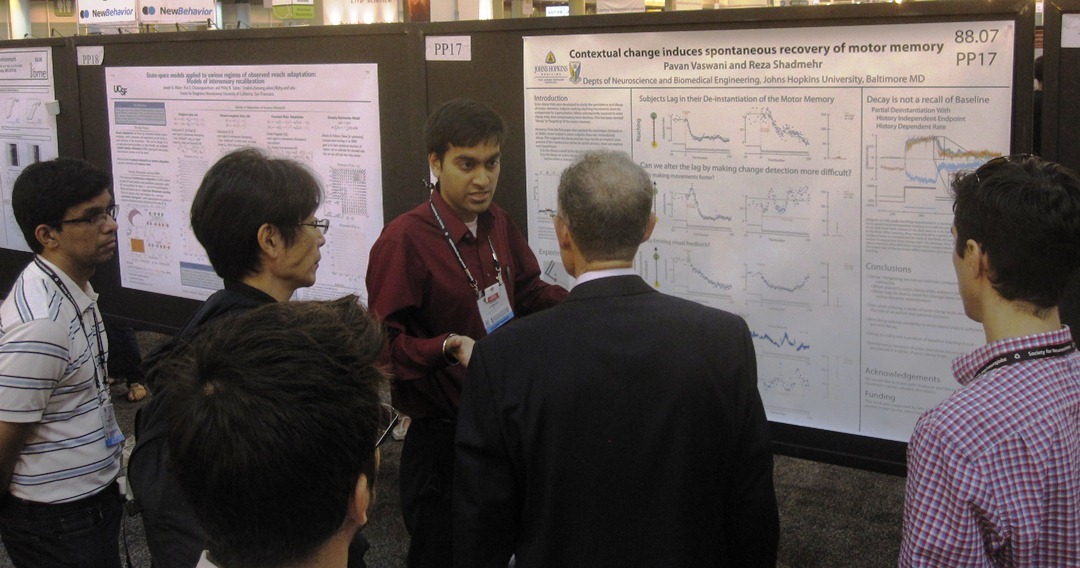
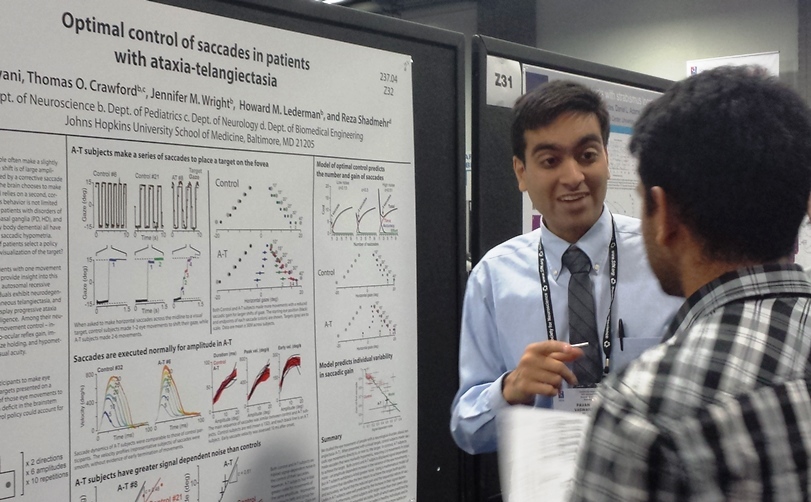
Pavan joined the lab in 2011 as an MD/PhD student, after completing a BS in Computer Science, Neurobiology and Biochemistry from University of Washington. Pavan is a Goldwater, Gates, and Washington Scholar. Pavan's research demonstrated that trial-to-trial forgetting, a property of motor memory, is the reason why adaptation is often incomplete. Using optimal control theory, he investigated the question of hypometria and segmentation of movements in both healthy people and people with certain movement disorders. He discovered that these behaviors were a compensation that the brain had made in response to noise in the oculomotor system. Working with Jennie Choi, Pavan investigated the question of why some people exhibit high movement vigor (moving their eyes with high velocity), while others exhibit low movement vigor. He was able to link movement vigor to the reward system of the brain, suggesting that high vigor may be associated with steep temporal discounting of reward. This suggested that trait-like features of individuality, such as impulsivity, are related to trait-like features of movement, namely vigor. Pavan completed his dissertation in 2014. He subsequently returned to the medical school, completed the MD curriculum in 2016, and enrolled in the neurology residency program at Harvard. He subsequently was appointed Asst. Professor of Neurology at the Univ. of Pennsylvania School of Medicine.
Ideas developed by Pavan
Selected publications
Vaswani PA, Shmuelof L, Haith AM, Delnicki RJ, Huang VS, Mazzoni P, Shadmehr R, Krakauer JW. Persistent residual errors in motor adaptation tasks: reversion to baseline and exploratory escape. Journal of Neuroscience. 2015;35:6969–6977.
Vaswani PA. Action selection in motor control: error, reward, and time. PhD thesis, Johns Hopkins University. 2014.
Herzfeld DJ, Vaswani PA, Marko MK, Shadmehr R. A memory of errors in sensorimotor learning. Science. 2014;345:1349–1353.
Choi JES, Vaswani PA, Shadmehr R. Vigor of movements and the cost of time in decision making. Journal of Neuroscience. 2014;34:1212–1223.
Vaswani PA, Shadmehr R. Decay of motor memories in the absence of error. Journal of Neuroscience. 2013;33:7700–7709.
Gallery