Research
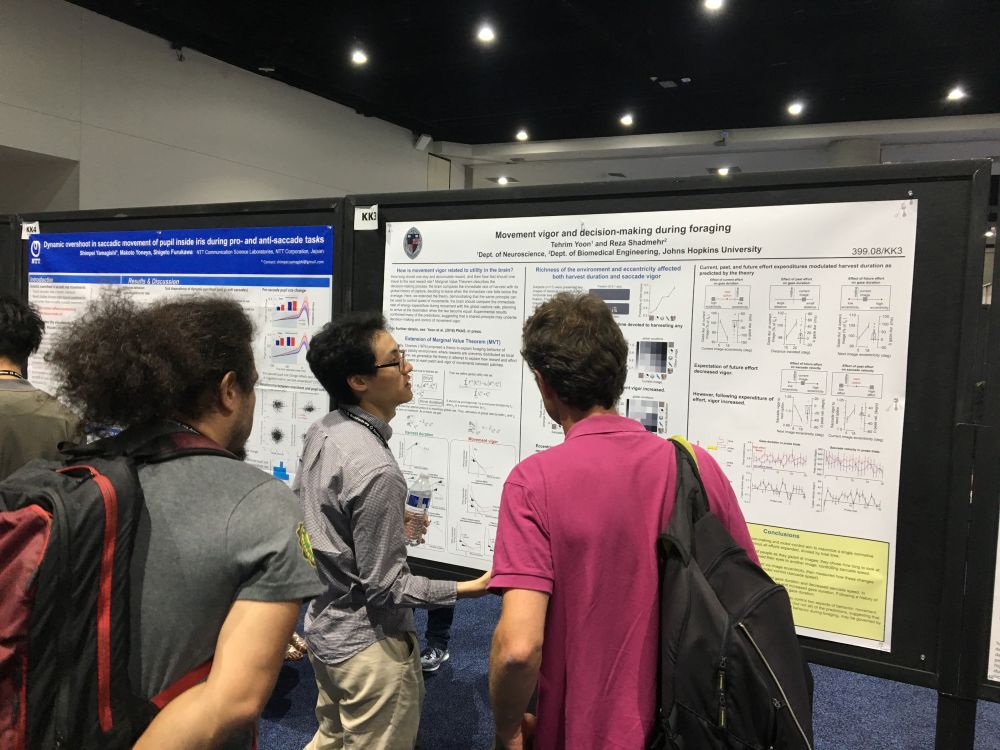
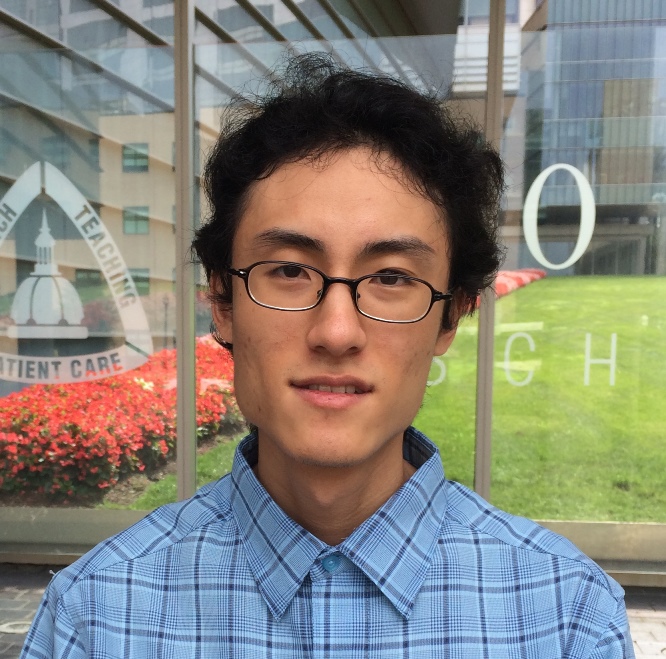
Tehrim joined the lab in 2015 as a PhD student in the Neuroscience program, after completing a double major in Physics and Chemistry at the Seoul National University, South Korea. Tehrim is the receipient of the Korea Presidential Science Scholarship, as well as a former member of the Korea Physics Team for the International Physics Olympiad. In 2010, he won the gold metal at the Physics Olympiad. In 2015, Tehrim was awarded the Samsung Fellowship to study abroad. His research focuses on using mathematics and psychophysics to describe neuroeconomics of human motor control. Tehrim's work showed that the theory of optimal foraging, which had focused on patterns of decision-making, could be applied to the question of how the brain controls vigor of movements. The experiments confirmed many (but not all) of the predictions of the new theory, suggesting that decision-making during foraging, and control of movement vigor, fundamental aspects of behavior during foraging, may be governed by a shared principle of control. He graduated in September of 2019.
Ideas developed by Tehrim
Selected publications
Yoon T, Jaleel A, Ahmed AA, Shadmehr R. Saccade vigor and the subjective economic value of visual stimuli. Journal of Neurophysiology. 2020;123(6):2161–2172.
Shadmehr R, Reppert T, Summerside EM, Yoon T, Ahmed AA. Movement vigor as a reflection of subjective economic utility. Trends in Neurosciences. 2019;42:323–336.
Yoon T. Control of movement in decision making: movement vigor, reaction, and their relationship with subjective value and effort. PhD thesis, Johns Hopkins University. 2019.
Yoon T, Geary RB, Ahmed AA, Shadmehr R. Control of movement vigor and decision making during foraging. Proceedings of the National Academy of Sciences (USA). 2018.
Gallery