Research
Thomas joined the lab in 2010 as graduate student in the BME PhD program, after completing a BS in Aerospace Engineering from Virginia Tech, and Post-bachelorette in Mathematics from University of Zaragoza, Spain. He was awarded a National Science Foundation Graduate Fellowship, and he is also a Fulbright Scholar.
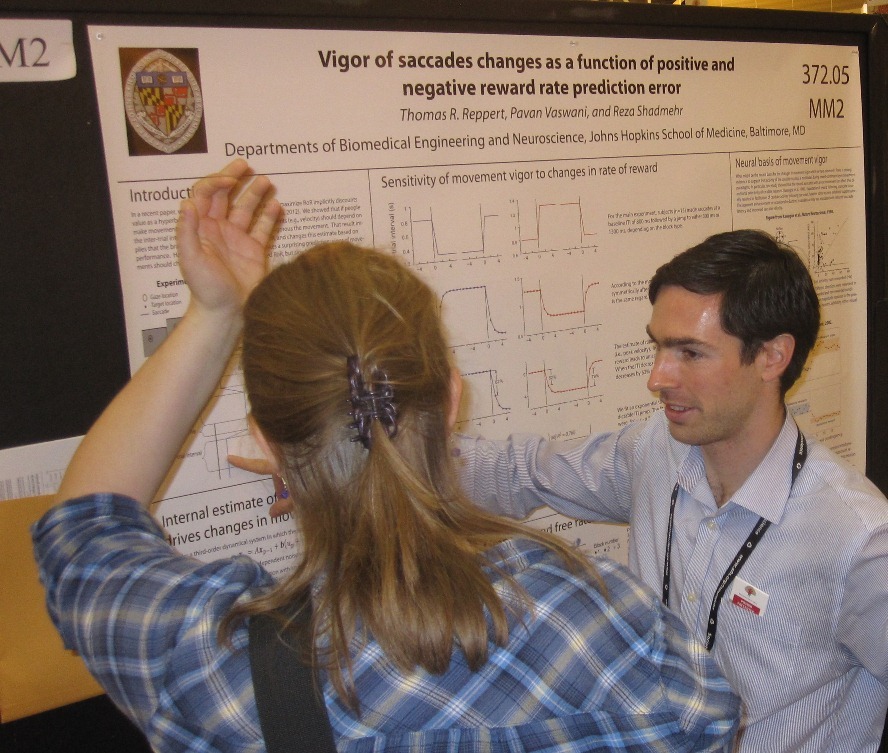
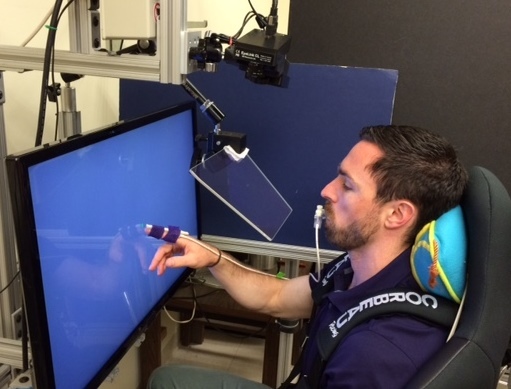
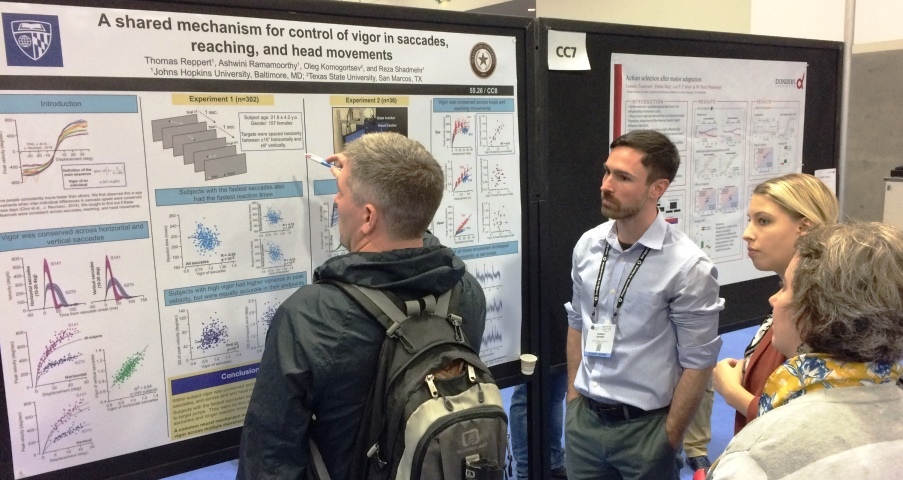
A common aspect of individuality is our subjective preferences in evaluation of reward and effort. The neural circuits that evaluate these commodities influence circuits that control our movements, raising the possibility that vigor differences between individuals may also be a trait of individuality, reflecting a willingness to expend effort. In contrast, classic theories in motor-control suggest that vigor differences reflect a speed-accuracy trade-off, predicting that those who move fast are sacrificing accuracy for speed. Tom tested these contrasting hypotheses by measuring motion of the eyes, head, and arm during various elementary movements (saccades, head-free gaze shifts, and reaching). He found that some moved with low vigor, while others moved with high vigor. Those with high vigor tended to react sooner to a visual stimulus, moving both their eyes and arm with a shorter reaction-time. Arm and head vigor were tightly linked: individuals who moved their head with high vigor also moved their arm with high vigor. In all modalities, vigor had no impact on endpoint accuracy, demonstrating that differences in vigor were not due to a speed-accuracy tradeoff. The results suggest that movement vigor may be a trait of individuality, not reflecting a willingness to accept inaccuracy, but demonstrating a propensity to expend effort.
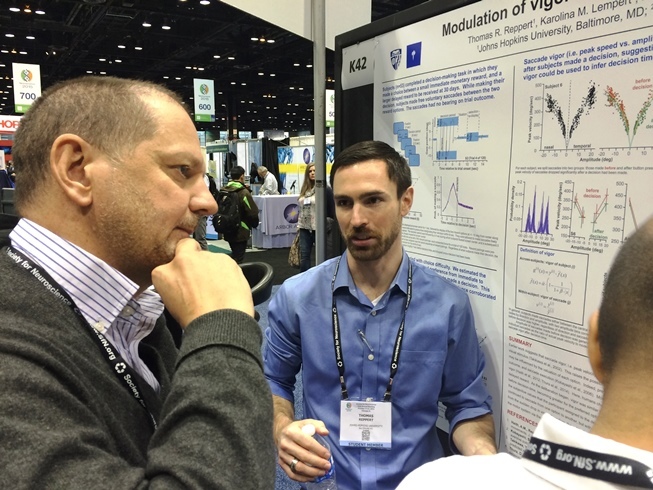
Tom's research moved the lab into the area of neuro-economics and its influence on human motor control. He discovered that during a decison-making task involving monetary options, saccadic movements of the eyes carried a vigor signal that reflected the subjective value that the brain assigned to each option. That is, saccade vigor was higher as the eyes moved toward the option that currently had the higher subjective value. Importantly, the vigor changes occurred before the decision was reached, demonstrating that vigor was potentially a real-time indicator of the decision-making process. He completed his thesis in August 2016, then did a postdoc with Prof. Jeff Schall at Vanderbilt University. Tom was subsequently appointed Asst. Prof. of Psychology at the University of the South.
Ideas developed by Tom
Selected publications
Reppert TR, Rigas I, Herzfeld DJ, Sedaghat-Nejad E, Komogortsev O, Shadmehr R. Movement vigor as a trait-like attribute of individuality. Journal of Neurophysiology. 2018.
Reppert TR. Movement vigor: consistency, conservation, and modulation. PhD thesis, Johns Hopkins University. 2016.
Reppert TR, Lempert KM, Glimcher PW, Shadmehr R. Modulation of saccade vigor during value-based decision making. Journal of Neuroscience. 2015;35:15369–15378.
Haith AM, Reppert TR, Shadmehr R. Evidence for hyperbolic temporal discounting of reward in control of movements. Journal of Neuroscience. 2012;32:11727–11736.
Reppert TR, Choi JES, Haith AM, Shadmehr R. Changes in saccade kinematics associated with the value and novelty of a stimulus. Conference on Information Sciences and Systems. 2012;46:1–5.
Gallery